Nutrition guide · protein · body weight
Protein: building material, not a competition.
Protein helps maintain muscle, organs, skin, enzymes and the immune system. But more is not automatically better: body weight, goal, total energy and health status all matter.
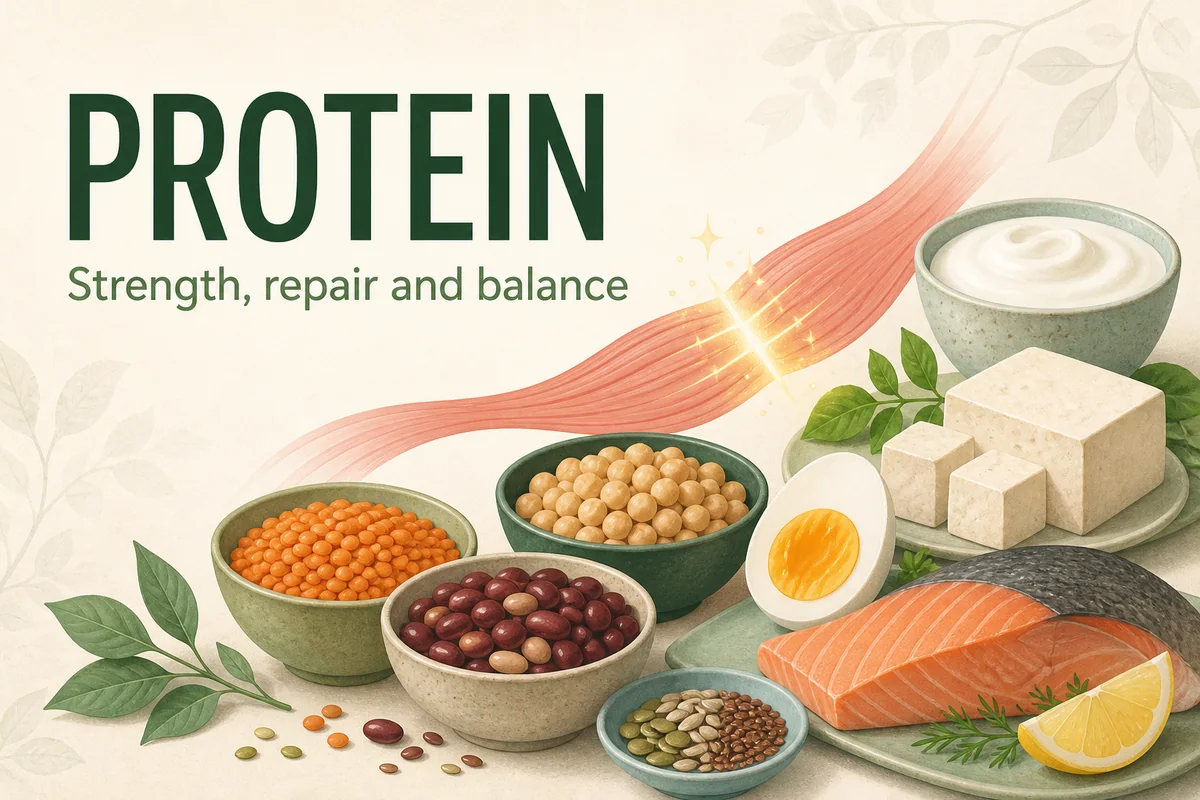
The role of protein
Your body uses it for daily repair and renewal.
Protein is made of amino acids. Some are essential because the body cannot make them and must obtain them from food. There is no dedicated large protein store, so a regular adequate intake matters.
Muscle and tissue
Protein maintains and repairs muscle, skin, organs and connective tissue.
Enzymes and signals
Many enzymes, hormones, transport proteins and antibodies are made from protein.
Fullness and body mass
Adequate protein can help preserve lean mass during weight loss and support fullness when the whole diet is balanced.
The app's actual logic
The minimum and maximum rise with body weight.
DailyBalance uses the latest recorded weight. Choosing weight gain automatically raises both coefficients.
Default formula
Maintaining or losing weight:minimum = weight × 1.6 g
maximum = weight × 2.2 g
Gaining weight:
minimum = weight × 1.8 g
maximum = weight × 2.5 g
For example, at 70 kg the app shows 112–154 g of protein, or 126–175 g when weight gain is selected.
If the macro split is changed manually, the weight formula no longer applies. Grams are calculated from the chosen protein percentage of energy and displayed as a ±10% zone.
Understanding the limits
The app minimum is not the same as a population reference intake.
EFSA sets an adult population reference intake of 0.83 g/kg/day, intended to meet the needs of nearly all healthy people. DailyBalance's 1.6–2.2 g/kg zone is a higher planning guide for weight management and tracking. EFSA has not set a tolerable upper intake level for protein; its report considers about twice the reference intake (roughly 1.66 g/kg) safe for adults, but that does not establish every higher intake as necessary or appropriate.
Persistently too little
Long-term inadequate protein and energy can reduce muscle mass and strength, slow recovery and wound healing, and impair immune function. Severe protein-energy malnutrition may cause oedema. A single day below the DailyBalance zone does not establish a deficiency.
Persistently too much
There is no universal harm threshold for healthy adults, but a very high intake can displace fibre-rich plants or healthy fats and add surplus energy. Source matters: large amounts of processed or fatty meat can add sodium and saturated fat. People with chronic kidney disease need an individual target because the kidneys remove protein metabolism waste.
Amount + source
A protein number never tells the whole story.
Plant sources
Beans, lentils, peas, soy, nuts and seeds provide protein together with fibre and unsaturated fats. Variety across the day is more important than making a “perfect” amino acid pairing at every meal.
Animal sources
Fish, eggs, lean meat and dairy provide all essential amino acids. Consider saturated fat, sodium and processing as well as protein.
Distribution
Spreading protein across several meals makes the target easier to reach while preserving room for vegetables, grains and healthy fats.
- ✓Track the trend.
Use several days or a weekly average rather than judging one meal. - ✓Do not add supplements automatically.
Protein powder can be convenient, but it is not required when ordinary food meets your needs. - ✓Personalise when needed.
Pregnancy, older age, intensive training, illness, healing and kidney health may change the right amount.
Sources and note
The number must be personally meaningful.
This article provides general education. DailyBalance is not a medical device, and its calculated zones do not replace an individual plan from a doctor or registered dietitian.
- EFSA — Population reference intakes for protein
- EFSA — Dietary Reference Values for nutrients: Summary report
- NIDDK — Healthy Eating for Adults with Chronic Kidney Disease
Reviewed 23 August 2026. Formulae checked against the default calculation logic in this version of `app.html`.