Nutrition guide · fats · quality
Fats: both amount and type matter.
Fat supplies energy, supports vitamin absorption and provides essential fatty acids. “Good” and “bad” are convenient shorthand, but unsaturated, saturated and trans fats are more useful terms.
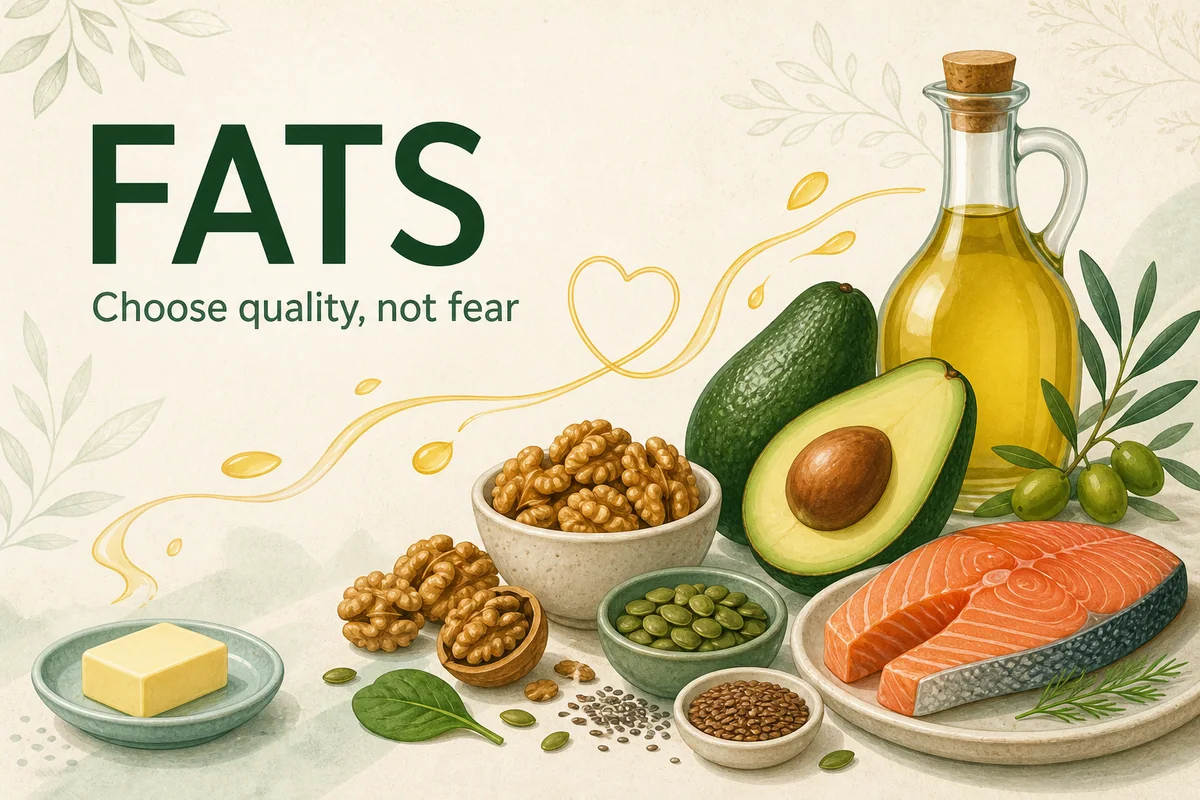
The role of fat
Fat is not a mistake — it is an essential part of eating.
One gram provides about 9 kcal, making fat a concentrated energy source. Fat is part of cell membranes, helps absorb vitamins A, D, E and K, and supplies linoleic and alpha-linolenic acids that the body cannot make.
Energy and fullness
Fat raises a meal's energy density, slows digestion and can contribute to longer-lasting fullness.
Vitamin absorption
Adequate dietary fat supports the absorption of the fat-soluble vitamins A, D, E and K.
Essential fatty acids
Omega-6 linoleic and omega-3 alpha-linolenic acids must come from food such as oils, seeds and nuts.
The app's actual logic
The fat zone directly depends on body weight.
DailyBalance calculates separate guides for total, saturated and unsaturated fat.
Default formula
Total fat minimum = weight × 0.6 gTotal fat maximum = weight × 1.0 g
Saturated fat maximum = daily kcal × 10% ÷ 9
Unsaturated fat minimum = total fat minimum − saturated maximum
The unsaturated fat maximum is the same as the total fat maximum. If the subtraction would be negative, the app displays an unsaturated minimum of 0 g.
For a 70 kg person maintaining weight, the defaults are 42–70 g total fat, about 23 g saturated fat maximum and at least about 19 g unsaturated fat. Manual settings or the weekend offset can change the displayed figures.
“Good” and “bad” fats
Those labels are simple; fat type is more precise.
| Type | Common sources | How to interpret it |
|---|---|---|
| Unsaturated | Olive and rapeseed oils, nuts, seeds, avocado and fish | These should make up most dietary fat. Replacing saturated fat with unsaturated fat improves the blood lipid profile. |
| Saturated | Fatty meat, butter, cream, full-fat cheese, palm and coconut oil | WHO recommends less than 10% of energy. Replace it with unsaturated fat or naturally fibre-rich foods. |
| Trans fat | Some fried and baked foods and products with partially hydrogenated oils; small amounts in ruminant meat and dairy | Keep below 1% of energy and avoid industrial trans fat. There is no beneficial minimum. |
Minimum and maximum
A deviation is not a disease, but a repeated pattern can matter.
EFSA's adult reference range for total fat is 20–35% of energy. DailyBalance uses a weight-based 0.6–1.0 g/kg zone, so the two guides will not always match gram for gram.
Persistently too little
A very low-fat, poorly planned diet can fail to provide essential fatty acids, impair absorption of vitamins A, D, E and K, and reduce both energy intake and fullness. Overt essential fatty acid deficiency is rare in healthy people but is more plausible with malabsorption or a highly restrictive diet.
Persistently too much
Because fat is energy-dense, excess intake can readily add a calorie surplus and promote weight gain. Type is crucial: persistently high saturated and trans fat raises LDL cholesterol and cardiovascular risk. A high intake from unsaturated sources is not equivalent, but it can still exceed energy needs.
Everyday practice
Small substitutions beat fear of fat.
- ✓Use liquid plant oils more often.
Olive or rapeseed oil is usually a better everyday choice than butter or hard tropical fat. - ✓Include fish, nuts and seeds.
They help supply unsaturated and essential fatty acids. - ✓Read the right lines.
Check saturated fat and look for partially hydrogenated oils in the ingredients rather than relying on “cholesterol-free”. - ✓Keep portions visible.
A spoon of oil, a handful of nuts and half an avocado can be excellent choices, but their energy adds up.
Sources and note
Amount works together with quality and energy.
This article provides general education. DailyBalance is not a medical device, and its calculated zones do not replace an individual plan from a doctor or registered dietitian.
- EFSA — Dietary Reference Values for nutrients: Summary report
- WHO — Saturated fatty acid and trans-fatty acid intake guideline
- WHO — Updated guidelines on fats and carbohydrates
Reviewed 23 August 2026. Formulae checked against the default calculation logic in this version of `app.html`.